

The challenge: full circles, scattered notebooks
In Quran memorisation circles, dozens of students recite every day, while memorisation, revision, mistakes and attendance are written into paper notebooks spread across teachers. Within weeks it becomes hard for a teacher to know which passages are starting to fade, for the administration to see which circles are thriving and which need care, and for parents to know how their child is doing beyond a quick word at the door.
Itqan: the whole circle in one place
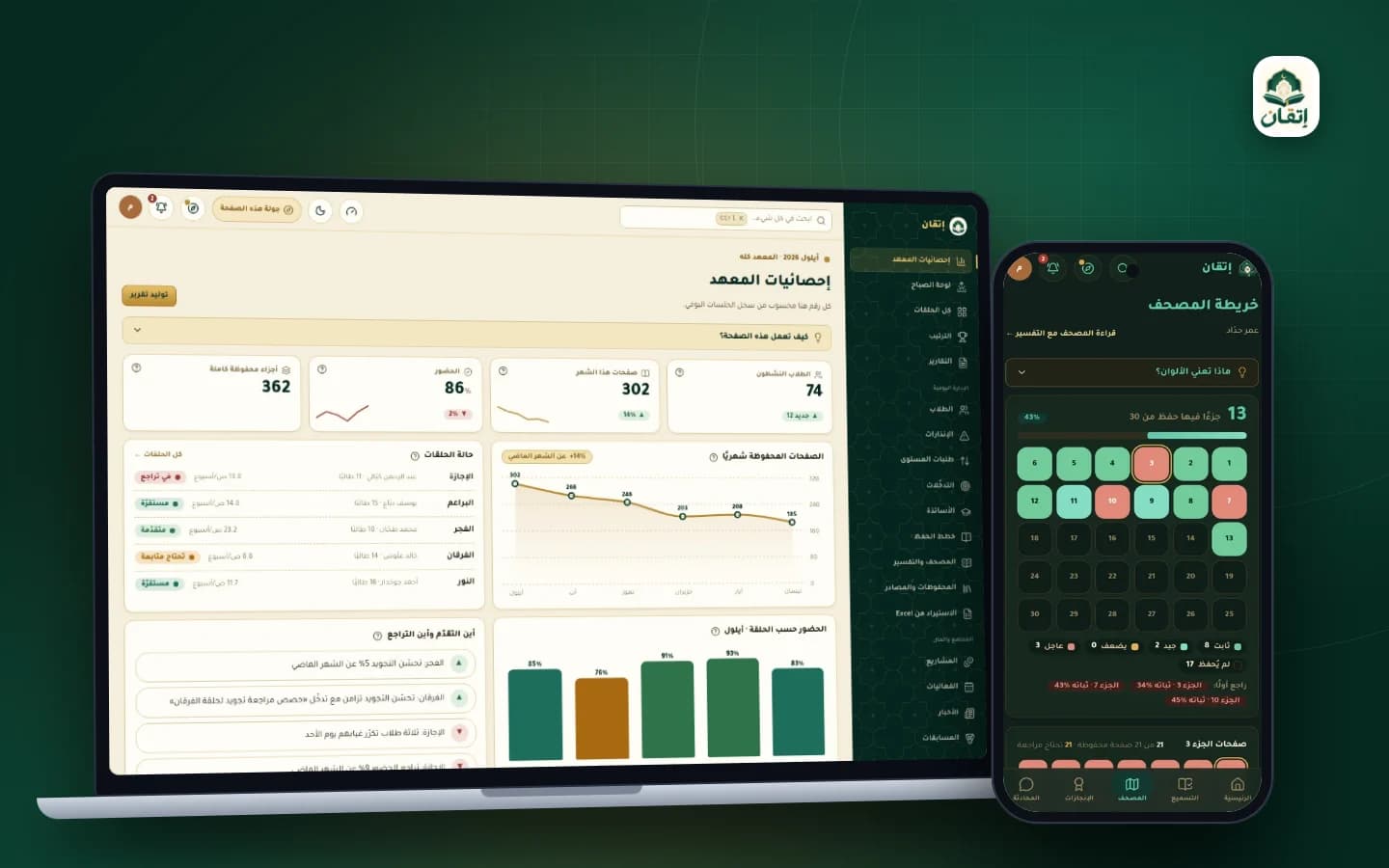
Itqan is built around the circle as it really works: a teacher who listens, a student who memorises, an administration that oversees. Teachers record a session from their phone in minutes and mark recitation mistakes directly on the words of the Mushaf, turning daily sessions into a clear picture of every student, every circle and the institute as a whole.
The Mushaf map shows how firmly each juz and page is memorised, fading as time passes without revision.
Early alerts notify the teacher when signs such as absences or declining memorisation add up, before a student drifts away.
Evaluation criteria and weights are set by the administration, which can preview their effect on rankings before adopting them.
Circle sessions work offline and sync once the connection returns.
Who it serves
Administration: institute statistics, every circle at a glance, a morning board of what needs a decision today, and print-ready reports.
Teachers: a fast session screen on the phone, a circle-wide memorisation map, and alerts about who needs attention.
Families and students: a private portal that parents open with a personal link to see the next assignment, the memorisation map and badges, and to log home recitation.
In service of the mosque
Itqan is in use today at Masjid Houria, with dedicated desktop and phone interfaces and a design inspired by the ornament and colours of the Mushaf, so that it remains a tool that helps the people of the Quran reach mastery rather than another burden on their day.